View article without comments
Pie in the Sky: Downtown Development District Presents Land (and Sky) Use Plans
by Darwin BondGraham
Wednesday, Oct. 08, 2008 at 1:11 PM
darwin@riseup.net (email address validated)
N.O. Council member Stacy head officiated the DDD meeting and was praised as a consensus builder by developers and preservationists alike for providing leadership toward a solution that addressed the concerns of both parties. Head, well known for her leadership in the demolition of public housing touted the DDD plan as one that put an �academic background and expert opinion around the issue,� and provides various stakeholders with influence over the final reports recommendations. This was in stark contrast with her leadership during the debate over the future of public housing when she eschewed attempts to forge common ground between those who sought homes for residents of the �big four� developments, and those who advocated immediately tearing down the developments: head was adamantly for demolition and entertained zero discussion with public housing residents and their allies about how to provide immediate affordable housing opportunities for working class New Orleanians.
first480.jpg, image/jpeg, 480x316
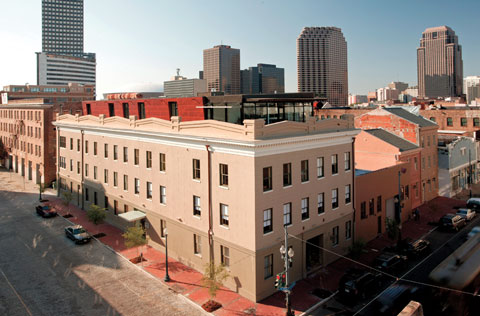
Wednesday, October 8, 2008 � Last night the New Orleans Downtown Development District presented its plan for rezoning building heights within a huge area encompassed by Poydras St., Convention Center Blvd., the Pontchartrain Expressway, and Loyola Ave., roughly 64 blocks of centralized urban landscape.
Prepared by H3 Studio, a St. Louis based firm that is among the big five selected through the UNOP process for neighborhood planning in the wake of Katrina, the plan calls for reconciling a major contradiction that has emerged among the downtown's power brokers. On the one hand developers seek to intensify land use by building upward with condos, hotels, malls, offices and parking structures. On the other hand, preservationists seek to maintain a certain aesthetic quality to the warehouse district, the area in question.
Following Katrina many developers moved quickly to build high-rise condo projects downtown. Six major development projects were announced in less than one-year. Part of the condo craze grew out of the disaster capitalist tendencies of both developers and affluent urbanites who saw both threats and opportunities to be had. According to one Metarie-based real estate adviser, �the belief is owners want a secure environment � safe from flood, wind and robbery � in a locale that did not flood with a view, which they can treat as a part-of-the-year home. I believe this will be a growing market.� The rush to build gated high-rises along the Mississippi River's natural high-ground levee remains intense.
Among the most notorious projects to sprout up just before Katrina was the Trump Tower on Poydras. Just after Katrina a proposed 17 floor development in the heart of the Warehouse district was floated. According to the Times-Picayune's Bruce Eggler, �the study of height limits in the Warehouse District and Lafayette Square neighborhoods grew out a controversy over a proposed 17-floor condominium building at Julia and Carondelet streets that opponents said would be out of scale with a low-rise neighborhood.� Fearing for the integrity of their neighborhood, its beauty and viability as an exclusive enclave of art galleries, law firms and condos, preservationists attempted to block development.
Another project spurring the study, the Tracage, a 24-story building in the warehouse district elicited much awe and disdain from various camps when it was announced. Other proposals for tall buildings to house wealthy urbanites quickly jelled (although only a few are actually now being built). These plans quickly ran into the entrenched interests of the preservationists community � mostly New Orleanians interested in maintaining a historical aesthetic. This has been and remains a core contradiction among the city's small property owners, the middle class, and the real estate businesses, particularly developers.
N.O. Council member Stacy head officiated the DDD meeting and was praised as a consensus builder by developers and preservationists alike for providing leadership toward a solution that addressed the concerns of both parties. Head, well known for her leadership in the demolition of public housing touted the DDD plan as one that put an �academic background and expert opinion around the issue,� and provides various stakeholders with influence over the final reports recommendations. This was in stark contrast with her leadership during the debate over the future of public housing when she eschewed attempts to forge common ground between those who sought homes for residents of the �big four� developments, and those who advocated immediately tearing down the developments: head was adamantly for demolition and entertained zero discussion with public housing residents and their allies about how to provide immediate affordable housing opportunities for working class New Orleanians.
Entitled �The New Orleans Upper CBD Height Study,� the DDD plan calls for building out horizontally in order to use 100% of the real estate footprint. Doing so will allow for shorter buildings but a significant amount of square footage for condos, apartments, hotels, restaurants, theaters, and other gentrified accommodations planned for the area. Affordable housing stock did not appear to be incorporated into the plan in any significant way. H3 Studio's presentation only mentioned a vague commitment to �diverse� economic development and fixated largely on the trendy concept of �mixed use� buildings. The plan calls for a stepping effect whereby buildings on the periphery of the district can reach heights not permitted in the center of the district. The tallest buildings appear to be slated for construction along Poydras and Loyola Ave.
According to the DDD's web site, �The Downtown Development District of New Orleans (DDD) was created by the Louisiana Legislature in 1974 as the nation's first assessment-based business improvement district (BID) to provide enhanced services in economic development, cleaning and safety. The DDD services the area bounded by Iberville Street, the Pontchartrain Expressway, Claiborne Avenue and the Mississippi River. The DDD is governed by an 11-member Board of Commissioners who represent a cross section of the diverse Downtown community. Appointed by local elected officials, our commissioners help guide the policies and programs of the DDD.�
The DDD was one, if not the first assessment based improvement district in the US. Commonly called Business Improvement Districts (BIDs), these publicly chartered-privately governed entities were created by local real estate interests and powerful businesses across the US from the 1970s through the present in order to wrest control of local governance from democratic elections, reforendums and city-wide tax and policy processes, and to created a privatized political economy to promote the interests of the most powerful property owners and large corporations. BIDs have played major roles across the US in gentrifying many downtown areas. They commonly hire their own para-police forces and form tasks forces to combat graffiti, sweep houseless populations from their areas of influence, and block the development of unprofitable public accommodations such as shelters or clinics. Their emphasis tends to be on profit maximization and control of space against certain �undesirable� populations.
darwinbondgraham.blogspot.com
dsfadsfa
by jsdafjjjj@163.com
Monday, Nov. 03, 2008 at 1:39 AM
kjasdfajkk@163.com
中国癌症网 肝癌 肝癌 肺癌 肺癌 胃癌 胃癌 肾癌 食道癌 子宫颈癌 乳腺癌 卵巢癌 直肠癌 结肠癌 皮肤癌 甲状腺癌 胰腺癌 前列腺癌 膀胱癌 骨癌 鼻咽癌 脑瘤
好狗网
|



