View article without comments
The Cuban Five: Mission against Terror
by posted by F Espinoza
Wednesday, Aug. 08, 2007 at 4:01 PM
This interview with Leonard Weinglass, appeals attorney for Antonio Guerrero was conducted by Gloria La Riva, coordinator of the National Committee to Free the Cuban Five, on August 1, 2007.
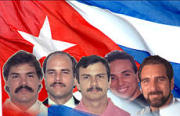
201.jpg, image/jpeg, 180x116
The Cuban Five: Mission against Terror
Interview with Leonard Weinglass
August 6, 2007
Exclusive to:
http://www.freethefive.org
This interview with Leonard Weinglass, appeals attorney for Antonio Guerrero was conducted by Gloria La Riva, coordinator of the National Committee to Free the Cuban Five, on August 1, 2007.
Gloria La Riva: Mr. Weinglass, the oral argument hearing in the Cuban Five appeals will take place before the 11th Circuit Court of Appeals in Atlanta, on Aug. 20. Can you please explain the current stage of the Cuban Five case? What are the issues which the defense will present?
Leonard Weinglass: The argument will be before a two-judge court. Possibly that court will be increased to a three-judge court but we won�t know that until a week before the argument. This is the same court that initially heard the case and decided in Aug. of 2005 that the Five did not receive a fair trial in Miami.
That 2005 decision was reversed by the entire 12 judge panel of the 11th circuit, voting 10 to 2, so the issue of venue is no longer available to us. But the rest of the case�aside from the issue of fair trial and venue�has been returned to the original court, now composed of two judges with the possible addition of a third, for consideration of all the remaining issues. The third judge retired from the bench approximately two years ago. Now we have a two-judge panel. It is possible that a third judge will be appointed to hear this case but we will not know that until a week before the arguments.
GLR: What are the issues on appeal?
LW: There are a number of remaining issues, but I will highlight the three most important ones most likely be addressed in the argument.
First is the issue of whether or not Count 3, alleging a conspiracy to commit murder against Gerardo Hernandez�arising out of the shoot-down by Cuba of two aircraft in 1996�can be sustained on appeal.
The defense is arguing that the evidence on that alleged conspiracy is insufficient as a matter of law. The argument is strong because the government at one point in the litigation acknowledged that their evidence was very weak and that they in fact could not prove that count. It is also impacted by the fact that the appeals court, when we originally argued the case in March of 2004 [first oral argument before the three-judge panel], also expressed its opinion that the evidence on that count was weak. So our initial focus is to remove Count 3.
I should also point out that this is the first time in history that an individual is being held liable for the action of a sovereign state in defending its airspace. Count 3 should never have been indicted in the first place because Cuba had the right to defend its airspace in shooting down these aircraft. But even assuming that it is legally viable, it was never proven.
The second argument that will take a considerable amount of the court�s attention, is the question of prosecutorial misconduct, particularly the misconduct of the prosecutor [U.S. Attorney John Kastrenakes] in his final argument to the jury.
Closing argument is constrained by very precise rules of law that prohibit counsel from arguing outside the scope of the evidence. In other words, a prosecutor cannot make claims in the final argument that are without any evidence or proof in the case. In this particular instance the prosecutor went far beyond the bounds of proper argument.
For example he claimed at one point that the Five came to the United States, not to monitor the activities of the terror network that had been assaulting the Cuban people, but instead he argued that their purpose in coming was to destroy the United States. That was mentioned not once but three times in the course of his argument. The Five were unarmed, they carried no explosives, they committed no acts of sabotage or arson, they threatened no one, and yet the prosecutor made that claim.
We contend that that is outrageous prosecutorial misconduct and because of that, both the count alleging conspiracy to commit murder and the count alleging conspiracy to commit espionage, which were closely-argued counts, must be set aside and a new trial ordered on those counts.
The third argument that will have prominence is the question of the sentencing of the three of the Five who were accused of conspiracy to commit espionage [Gerardo Hern�ndez, Antonio Guerrero, Ram�n Laba�ino]. Each of the three who were so accused received a life sentence. A life sentence now means that you actually serve your entire life without getting out of prison prior to your death. This case was the first case in the history of the United States where there were no classified documents involved. That is, there was nothing in the nature of a national-security-published matter that was in this case.
The notorious cases related to espionage historically are cases involving individuals who turned over to a foreign country, scores, sometimes hundreds and thousands of state secrets. In those cases these individuals�the most notorious of whom are people like Robert Hansen, of the FBI, Aldrich Ames of the CIA, Robert Walker of the Navy, who gave hundreds if not thousands of documents�each received life.
But in the case of the Five there were no such documents. Nonetheless the three are serving the same life sentences as these most notorious spies. So we are arguing that this sentence, given the facts of this case, is oppressive, irrational and outside the bounds of the statutory scheme. It was a sentence that obviously was reserved for Cuban patriots who took up the responsibility of exposing and trying to prevent the terror that emanates from the United States directed against Cuba.
Those are the two main charges of the 26 counts, and third, the prosecutorial misconduct of the prosecutor.
If we prevail on those issues, that will go a long way toward bringing the three who are serving life sentences, and all five men, back home to their families and compatriots in Cuba.
GLR: You mentioned that the prosecution did not present evidence to prove their charge of murder conspiracy against Gerardo Hern�ndez. This is an extremely unusual and irregular charge given that even the prosecution during the trial went to the 11th Circuit to appeal, with a �writ of prohibition� on the judge�s instructions, because the prosecution said they didn�t have the evidence to convict. Specifically what was required for a conviction which the prosecution failed to prove?
LW: What was required for a conviction under U.S. law was proof beyond a reasonable doubt that Gerardo Hern�ndez had entered into an agreement whose objective was to bring about the deaths of four individuals who died when their planes were shot down. There is no evidence whatsoever that Hern�ndez had any knowledge the shoot-down was to occur. And therefore the case failed in terms of its evidence.
Beyond that, there should not even have been a charge of that nature. That charge was unprecedented because Cuba, a sovereign state, was seeking to protect its own airspace, and in so doing, its military aircraft brought down intruding aircraft. That activity has never before resulted in an indictment against an individual who was in no way involved in the military action.
GLR: Didn�t the prosecution also claim that Gerardo Hern�ndez knew the planes would be shot down in international waters? Yet, Gerardo was not part of any plan for the shoot-down, although it was a justified and legal act by Cuba.
LW: That is correct. There is no evidence that he knew that there was going to be a shoot-down. The only evidence at trial was that he received a message from Cuba that his compatriots were not to fly in the Brothers to the Rescue aircraft during that period of time.
[Note: BTTR had invaded Cuban airspace numerous times in 1995 and 1996 despite repeated warnings from Cuba. BTTR�s leader, convicted terrorist Jos� Basulto, had boasted publicly to the Miami press that on Feb. 24, 1996, his organization would fly planes over Cuba, and he persisted in ignoring the warnings from various U.S. and Cuban authorities. The Cuban government, the U.S. State Department and the U.S. Federal Aviation Administration all notified Basulto that Cuba was prepared to take direct action to stop further unauthorized incursions into Cuban airspace.]
Where the planes were shot down was not directly relevant, although the prosecution�s argument was that Hern�ndez was allegedly a part of an agreement to shoot down the planes in international waters.
Hern�ndez was not told why his compatriots who infiltrated BTTR were not to fly, and he was not informed of what was to happen. He was simply told that his compatriots who were there with him were not to fly. That was far from saying that he had knowledge that there was going to be a shoot-down.
GLR: With regard to the life sentences, you have explained that there is no possibility in federal prison for parole or early release except when the prisoner dies. Has this doctrine of life without parole always existed, and if not, when did it change?
LW: Parole has been abolished in the federal system in the United States and I believe that change occurred in approximately 1994. The case of the Five arose in 1998, it arose after the change, therefore the Five were sentenced under the new rule which abolished parole.
GLR: Prisoners who were sentenced to life before 1994, are they eligible for parole?
LW: Yes. I believe they begin to be eligible when they have served approximately 32 or 34 years.
GLR: How does this case affect the guarantees to legal justice that most people have come to expect in the courts? And what more can be done for the Five in court with regard to the venue?
LW: The ruling on venue�which we could appeal at a subsequent time to the U.S. Supreme Court�affects everyone who is brought before the bar of justice in America. The venue rules prior to this decision are rules designed to protect a defendant against being brought to trial before a community that is impassioned as a result of prejudice against the accused. This fundamental and hallmark part of the criminal justice system was undermined by the decision of the 11th Circuit sitting en banc in August of 2006.
If we lose before this panel, we will then have the right to raise the venue issue before the United States Supreme Court. So it affects everyone who is forced to trial in America.
The question of sentencing will also affect everyone who is charged with conspiracies to commit espionage, because of the draconian nature of the Five�s sentence.
The murder conspiracy charge against Gerardo Hern�ndez will be a first-time precedent, charging a person within the United States with a conspiracy to commit murder for an outside sovereign�s right to protect its own airspace. So this case in many ways will have impacts on the state of the law in the United States.
GLR: Despite the obstacles imposed by the trial judge, the attorneys for the Five tried to show the long history of terrorism in Miami and the sole reason for the Five�s mission in Miami, to stop that terrorism. Since their convictions there have been discoveries, revelations of continued plots against the Cuban people by the Miami-based terrorists. And of course, in May, one of the most notorious, Luis Posada Carriles, was freed to join his accomplices in Miami.
What role could these developments play in the struggle for the Five�s freedom?
LW: Of the nine issues that will be argued before the two-judge panel, I only mentioned the three main issues that we will be arguing. There are six additional issues. One of them is the issue of justification. Under American law, a person who is accused of a crime could acknowledge committing that crime, and then argue that committing the crime was justified out of necessity to avoid a greater harm. It is a form of self-defense, extended to acts which will protect other parties. This was argued in the original trial. But the trial judge [Joan Lenard] took that issue away from the jury, so it was never considered by the jury. We claim that that was error. We will be arguing that the �defense of necessity� claim should have been submitted to the jury, because the Five came to the United States in order to prevent additional violence, injury and harm to others.
The reason why I didn�t mention it initially is that the courts in the United States have a tendency to discredit that defense, particularly in the political context in which it was raised in this case. However, look at the revelations involving Posada Carriles and Orlando Bosch and others, whom the government has conceded were involved in acts of terrorism.
The Five came here to curb their activities. This case presents a stronger record, than any case I am aware of, for the argument that the Five�s activities were justified and necessary in order to save lives.
GLR: Do you have an example of how the defense of necessity has been used?
LW: I used it successfully in the defense of President Carter�s daughter, Amy. She occupied a building, with other students, at the University of Massachusetts, in opposition to the CIA agents who came to the campus to recruit students into the CIA. She acknowledged that her occupation of the building was a crime but she argued that that was justified by the doctrine of necessity because the CIA was then engaged in an illegal war in Nicaragua.
It was argued to the jury and Amy Carter and her sixteen other student defendants were all acquitted.
GLR: If sufficient relief for the Five is not won in this appeal, is there any possibility of an appeal, on the basis of the original argument of their anti-terrorist mission?
LW: Well, the trial lawyers did a very good job in bringing before the court and jury 35 exhibits demonstrating a long history of terrorist violence directed against Cuba from the southern Florida area. They also produced live witnesses who were involved in those actions, for the jury to see and hear. In fact, our original panel of three judges, when they wrote a 93-page opinion reversing the case because of the prejudice in Miami, cite in footnotes the evidence that was produced in court, and refer to Posada Carriles as a terrorist. I think it is the first judicial finding that those activities directed against Cuba were in fact terrorist activities. [The Aug. 9, 2005 93-page opinion is accessible on our website.]
That was all before the judge in the original trial, but the judge took that issue away from the jury. Now, if we lose this appeal, can we file a new appeal under habeas corpus, incorporating some this new information which has come to light since the end of the trial? The answer is probably yes, and it is something that we will definitely look into because we are keeping records of all the new information, once this argument is concluded and once we have a decision.
GLR: The defense is focusing on three main issues in the oral argument. Is that because of the defense team�s time limit of 30 minutes or the limits you have overall in the appeal?
LW: The appeal comprises a trial record of 119 volumes of transcripts, 20,000 pages of exhibits. We have been given a total of 30 minutes to argue all nine issues. If you spread that out, it gives us three minutes per issue. As happens with respect to all appeals, the lawyers have to make a judgment as to which issues they will be arguing. After meeting with all counsel, we have focused on three issues that we will feel will bring about a reversal of the major charges, and set the path for the release of the Five.
But it still only gives us 5 or 6 minutes for issues that we are trying to argue. The 30 minute limit does dictate the issues we will be able to argue and how much time we can spend on each issue.
GLR: Are you able to address all issues in the written briefs?
LW: They are all addressed comprehensively. There is also a limitation on the number of words you can put in a written brief, and we have used all the space that has been allocated to us in arguing all nine issues.
GLR: Have you been in recent communication with any of the Cuban Five?
LW: I am in most frequent communication with Antonio Guerrero. And I just received a letter from him dated July 19. His spirits as usual are very high. He is fully aware of what is happening in court, and the arguments we are about to make. He remains strong and optimistic.
GLR: You have a long history of defending political activists since the 1960s. In this case, with the worldwide and U.S. movement of support for the Five�s freedom, how do you see the importance of the political support in regards to this case?
LW: This case is the first case in our memory that it will be argued a third time on appeal. To all of our collective memories, this has never happened before. Why is it happening in this case? We believe it is because of the international and domestic attention that this case has received. As lawyers we know we have the right to argument and we have the right to written appeals. But we also know from experience that whether or not the arguments are heard or the appeals are taken seriously frequently depends upon how extensive the support is, and how broad the interest is in the case.
It is a tribute to all those supporters who have worked diligently to bring the case of the Cuban Five to the public�s attention, that we have the opportunity to present oral argument a third time. We cannot rest until Gerardo Hern�ndez, Antonio Guerrero, Ram�n Laba�ino, Ren� Gonz�lez and Fernando Gonz�lez are home in Cuba with their families.
Thank you very much.
See also:
http://youtube.com/watch?v=CCdGdpeNps8 Video: "Mission against Terror"
http://www.granma.cu/ingles/2007/agosto/lun6/32NYT.html "The New York Times" article
http://www.bbc.co.uk/worldservice/ondemand/rams/nh27166____2007.ram BBC interview with Gerardo Hern�ndez, one of the Cuban Five. Or read it at the site of: http://www.antiterroristas.cu
Other websites related:
http://www.antiterroristas.cu
http://www.freethefive.org
http://www.wicuba.org
http://www.freethefiveny.org
http://www.freeforfive.org
http://www.freethecuban5.com
http://www.cubasolidarity.com
http://www.cubasolidarity.net
http://www.cubasolidarity.net/solinumb.html
http://www.ifconews.org
http://18thcubacaravan.blogspot.com
http://www.granma.cu/miami5/ingles/index.html
http://www.cubainformacion.tv
http://www.cubacoop.com
http://www.cuba-humanidad.org
http://www.saludthefilm.net/ns/index.html
Free the Cuban Five!
by posted by F Espinoza
Wednesday, Aug. 08, 2007 at 4:01 PM

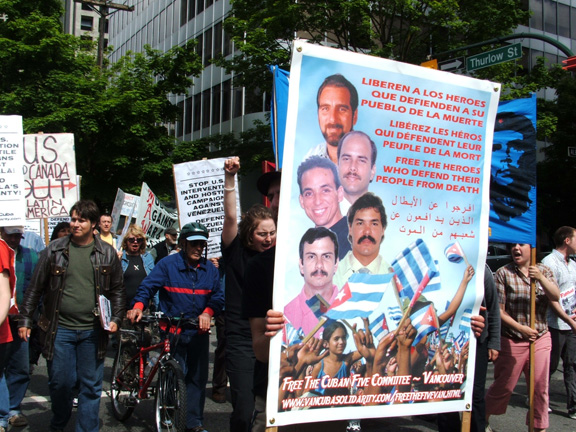
0605202.jpg, image/jpeg, 576x432
Free the Cuban Five!
by posted by F Espinoza
Wednesday, Aug. 08, 2007 at 4:01 PM

jan2707freethefivesf.jpg, image/jpeg, 868x577
Cuban Five
by posted by F Espinoza
Thursday, Aug. 16, 2007 at 4:28 PM

021603cuban5.jpg, image/jpeg, 450x328
The Cuban Five: Mission against Terror and Hypocrisy
A View from Atlanta: Deconstructing the Illusion of �Espionage�
by Rodolfo Davalos
August 12, 2007
Reprinted from:
http://www.juventudrebelde.co.cu/columnists/2007-08-13/a-view-from-atlanta-deconstructing-the-illusion-of-espionage
The allegation of �Conspiracy to gather and to transmit information on National Defense� is the technical charge, according to US criminal law (18USC & 794), commonly called �Conspiracy to commit espionage�. It is without doubt the central topic of the legal process against five Cuban prisoners wrongly held in the United States. One should recall that the Miami press once called theirs �the spy trial,�a description that used on other occasions in El Nuevo Herald during the trial itself.
For that crime, three of the men were each unjustly sentenced to life imprisonment. What is necessary is to rebut those accusations, to demonstrate the lack of evidence about the charges and reveal the innocence of the accused. This will be central task of the defense lawyers this coming August 20 before the three-judge panel in charge of hearing appeals presented to the Eleventh Circuit of Appeals in Atlanta.
This issue triggers discussion when one raises the case of the Five before any audience. The accusation of �espionage�(generically speaking) it tends to create concern by anyone who hears that dark and menacing description. Nonetheless, where the true conspiracy against the Five existed was on the part of the government of the United States, which crafted a macabre plan to discredit the accused and to present them as dangerous criminals, as enemies of the American people.
When unable to try the men for espionage, they accused them of �conspiring�to commit it, something ethereal, subjective. The presumption of innocence was reversed, since what was alleged by the prosecution was that �they had the intention of appropriating�supposedly �classified information�that never appeared, that has not been seen, that was not presented � nor could be it, which was never the intention. But that name is there in the charges, in the atmosphere that was created by the prosecution in the trial, and that they conveyed to the jury. The result: three sentences for life imprisonment.
One time I gave information on the unjust process to a German lawyer. He later spoke with me for several hours about how the crime of espionage is completely differs from what was carried out by the Five. The accusation was manipulated and tendentious, and what was even worse was the information given out by the press in Miami. The experienced and recognized lawyer, a progressive, previously did not have the correct information, yet since then he has never taken his eye off the case. Moreover, he continues to contribute his abilities to the just cause.
What is important is to explain what the Five were doing in United States and why. I remember that at the beginning this was a topic on the Cuban news/commentary program �the Round Table.�I was coming home one night after the program and ran into an old friend � a neighbor, a revolutionary above any suspicion. He yelled at me from saying, �Very well, professor, very well.�� yet immediately he came closer and whispered to me about the trial. �But they are spies,�he said. I couldn�t believe it, I froze! If that old revolutionary believed that the Five were spies what would others think? I invited him to come into the house and I explained to him:
�There are not spies without espionage. Espionage is a crime, and like all crimes it has to be �codified�in criminal law, that is to say described in the penal code as constituting an illegal action and therefore punishable.
The crime of espionage, according to American federal law itself, consists of appropriating, gathering and transmitting information pertaining to National Defense � information that is classified and protected by the State and would cause damage to United States if known by non-authorized parties.
What does that have to do that with the actions of the Five, with monitoring terrorist organizations and groups? Were there any classified documents protected by the State or relating to National Defense? This question was asked during the trial to US Army General Edgard Atkenson, the former head of the Office of Intelligence and an instructor at the Intelligence School of the Defense Department. He responded with a categorical �No.� They were not �spying.�
With this information, my neighbor ended up convinced that night, as convinced the three judges from Atlanta will end up.
If there is justice in Atlanta, this will end the dirty game of allegations of �spies�that has kept the five men in jail for nine years, despite the fact that known anti-Cuba terrorists Luis Posada Carriles �peacefully�walks the streets of Miami.
Justice cannot permit a similar infamy.
A Sun That Will Never Burn Out
by Ricardo Alarc�n de Quesada
February 11, 2002
Reprinted from:
http://www.ain.cu/patriotas2/documentos/alarconeng.htm
Early in the morning of Saturday, September 12, 1998, the FBI informed Ileana Ros-Lehtinen and Lincoln D�az Balart, hornblowers for the Batistian terrorist mob in Miami, that it had just arrested five purported �spies� living there.
Although the Florida Congressional Delegation comprises 25 individuals, none of the others were given advance notice by the investigators. At the time, the FBI had yet to ascertain the identity of three of the men arrested, while the other two held U.S. citizenship. The above-mentioned �legislators� do not occupy positions in Congress related to security or intelligence matters. Why this privilege? Why share information with them from an �investigation� yet to be made public?
Formal charges were not laid until four days later. But from the very beginning, it was clear that this was a case of a political-repressive operation, aimed solely at benefiting the most aggressive and violent sector of those who had turned South Florida into the main base for their war on Cuba since 1959.
The various counterrevolutionary factions and politicians and officials closely tied to them immediately unleashed a frenzied and hysterical campaign to stigmatize the five prisoners. There in South Florida, where almost all of the printed, radio and television media are controlled by the anti-Cuban mob or operate under its constant threat, not a day went by without the appearance of new articles or announcements, including statements by officials, slandering and denigrating the five by portraying them as dangerous enemies of society.
The real reason behind their unjust imprisonment was hidden. Not a word was published about the unblemished and honorable trajectory of their exemplary lives, in Cuba and the United States, as students, workers, fathers or citizens. Nothing was said about the selfless and admirable sacrifices they made to protect their country and its people. Nor was anything said about what had happened to them since the early morning hours of that September 12, or about the brutal conditions they suffered in one of the worst prison systems ever even imagined by humankind.
Gerardo Hern�ndez, Ram�n Laba�ino, Fernando Gonz�lez, Antonio Guerrero and Ren� Gonz�lez are victims of an abominable injustice and of cruel, inhuman and degrading treatment that blatantly violates their human rights and is irrefutable proof of the arbitrariness and illegitimacy of the legal proceedings to which they were submitted. From the day of their arrest until February 3, 2000, throughout 17 months, they were kept in solitary confinement, isolated from each other and from other prisoners. They were shut up the entire time in the �hole�, a term used to describe the unspeakable treatment reserved for part of the U.S. prison population. The legal representation for the five fought tenaciously until the men were finally integrated into the regular prison system. But the fact that this was accomplished in no way diminishes the unjustifiable atrocity committed against them. What is more, their treatment constituted a violation of U.S. prison regulations, which establish the use of solitary confinement solely as punishment for infractions committed in prison, and limit its length to a maximum of 60 days for the most serious cases, such as murder. They had obviously not violated any of the prison�s regulations before being imprisoned, nor had they ever killed anyone. Nevertheless, they were kept in total isolation, and it is worth reiterating, throughout 17 months.
During this lengthy period, it was impossible for them to maintain adequate communication with their attorneys and prepare their defense with the minimum guarantees of due process. If there were anything similar to justice in Miami, then for this sole fact, the court should have ordered their release and obliged the government to make adequate reparations.
But in Miami, when it is a matter of Cuba, there is nothing that even remotely resembles justice.
We should mention the commendable work done, in spite of everything, by the defense. The five defendants did not have attorneys of their own, nor the financial resources needed to hire them. As a result, they were assigned public defenders, with whom they had no prior relationship whatsoever. When these lawyers came to know the men they were defending, however, they were able to appreciate the purity of their motivations and the nobility and heroism of their conduct. And despite the profound ideological differences separating them � which they attested to in court � they became convinced of the absolute innocence of the five, as reflected in the personal effort they made to defend them, above and beyond their professional skill.
While the five heroes endured in the shadows and in utter solitude, their cowardly enemies occupied cameras, microphones and newspapers day and night to slander them and threaten their families and friends, as well as to administer �justice� Miami-style. You could read up on all the details of this so-called legal trial in the city�s slander sheets, including the details of additional charges that the prosecution would formulate many months later. This was how news came out, for example, of the most aberrant, absurd and false accusation of all � conspiracy to commit murder � presented for the first time by the prosecution in May of 1999. This took place after the prisoners had already spent eight months in jail in complete isolation, and following a shameful operation in the Batistian terrorist mob-controlled press and public and private meetings between the prosecutors and mob members, at which plans to put forward the fallacious charge were openly announced.
Holding a trial in this city with even the appearance of a normal legal proceeding was inconceivable. That it was impossible had been fully demonstrated even before jury selection. Yet the repeated requests made by the defense to have the trial moved to another city were turned down by Joan Lenard, the Miami federal judge to whom the case was assigned.
During that same time, an event took place that earned notoriety in the international press. Concerned over openly announced threats of violent acts, the organizers of the Latin Grammy Awards decided to move the ceremony originally scheduled to take place in Miami to Los Angeles. If it was not possible to judge the work of some of Cuba�s finest musical performers in peace in Miami, if they could not guarantee the safety of the participants in a concert there, as was publicly stated by the organizers, then who could possibly believe that a peaceful and impartial trial could be held there for individuals subjected to the most ferocious slander campaign imaginable and portrayed as �dangerous� agents of the Cuban Revolution?
Ms. Lenard offered no explanation as to why the trial had to be held there, only there, and nowhere else. But she did say something to the press that could provide the key to understanding her stubborn insistence: �this trial will be much more interesting than any TV program,� she proclaimed, erudite and severe, on March 16, 2000.
Of course, local television turned out to be indispensable for following the trial. It is only fair to acknowledge that the designated counsel responsible for the defense were not locked up in the �hole� along with the defendants, and unlike the latter, they were allowed to read newspapers, watch television and listen to the radio. We must also point out, however, that it was often through these media that the lawyers received news, long before any official communication was made, of the steps being taken by the prosecution, the purported �evidence� they claimed to possess, the charges that could be laid, and even the motions they raised in their obstinate efforts to introduce some semblance of legality into the midst of such arbitrariness and fraud.
And if all of the foregoing were not sufficient, there were numerous violations of procedure during the court sessions that even further vitiated a trial that was rigged and therefore nullified from the very outset. The defense attorneys were not allowed access to all of the �evidence� used to back the charges made. Instead, it was selectively doled out by the prosecution, which on more than one occasion introduced hundred of pages of new �evidence� without prior notice, or prevented the complete examination of the documents submitted, leading to repeated objections from the defense. The defense was denied its request for the inclusion of evidence, including official documents, that were fundamental for shedding light on the accusations made against the defendants. A number of witnesses were openly pressured by the prosecution, in front of the judge, right in the courtroom, in view of everyone, under the threat of being charged themselves if they revealed certain information. The court provided the counterrevolution�s mouthpieces with over 1400 pages of documents selected by the authorities which was blatantly manipulated by the local press and thus served to fuel the incessant and spurious propaganda campaign to demonize the accused. The media joined with the terrorist groups that freely operate there to organize public demonstrations as a means of pressuring the jury and the judge.
That is because, in spite of everything, the mob came to be seriously worried over the way the trial was unfolding. Fully aware of the absolute falseness of the charges made, they feared a verdict contrary to their purposes. They were particularly alarmed by the fact that the defense attorneys, through their talent and high degree of professionalism, had exposed the shady maneuvers of the prosecution and effectively put the mob itself on trial.
The evidence and arguments put forward by the defense were overwhelming. They clearly demonstrated the terrorist activities carried out from Miami against Cuba and the complicit tolerance exhibited by the U.S. authorities, which make it necessary for the Cuban people to defend themselves through the heroic efforts of men like the accused in the case. They made it abundantly clear that the defendants had not sought out information that would threaten the national security of the United States, and had caused no harm to anyone. Testimony to this effect was provided by officials from the FBI itself and the Southern Command, and high-ranking military figures who had held major positions in the U.S. armed forces. These included General Charles Wilhelm, former head of the Southern Command; General Edward Atkeson, former US Army deputy chief of staff intelligence; Rear Admiral Eugene Carroll, former assistant deputy chief of naval operations; and Colonel George Bruckner, who had occupied a high-ranking position in the command of the U.S. Air Defense System. Even General James Clapper, former director of the DIA (the intelligence agency of the U.S. Department of Defense), called to testify as an expert witness for the prosecution, acknowledged that the accused had not committed espionage against the United States.
At the end of five months of courtroom battle, in the most difficult and hostile conditions imaginable, the total innocence of Gerardo, Ram�n, Fernando, Ren� and Antonio and the guilt of their accusers had been made abundantly clear.
The accused had carried out no espionage activities whatsoever. They had neither obtained nor sought any information related to the security, defense or any other interest of the United States. They had done nothing to cause damage to that country or its citizens. Not a single piece of inculpatory evidence had been put forward. Not a single witness had uphold the charges.
Their selfless efforts had been focused, solely and exclusively, on infiltrating terrorist groups and informing Cuba of these groups� plans for aggression against the island. They never hid this fact. During the trial, it was thoroughly demonstrated that terrorist acts are carried out against Cuba from Florida, and that the U.S. authorities do nothing in response to these acts. As a result, in the exercise of its inalienable right, Cuba is obliged to defend itself from these activities which, as was also clearly demonstrated, have sometimes led to the loss of lives and serious damage for the people of the United States as well.
The most serious accusation, made against Gerardo Hern�ndez � conspiracy to commit murder, in connection with the incident of February 24, 1996 � is a colossal outrage and unprecedented stupidity. There is a lengthy record of the use of light aircraft taking off from Miami to carry out countless and repeated violations of Cuban airspace and to perpetrate numerous crimes, including shootings, bombings, and the dropping of chemical and bacteriological substances. All of this was amply documented during the trial. It was equally documented that before the date in question, Cuba had warned that it would not tolerate further incursions into its territory. Cuba�s defensive action against those who had once again violated its airspace, and right in front of the center of its capital, fully complies with international law. And independently of all of this, Gerardo had nothing to do with the decision carried out by the Cuban air force. He had no involvement whatsoever, in any way, with what happened that day. Consequently charging him with first degree murder and sentencing him to a second life sentence is quite simply the height of both outrage and stupidity. Never before in the history of the US had anyone been found guilty of first degree murder without a single witness, without a shred of proof, without putting forward even circumstantial evidence.
The terrorist mob, in despair, publicly acknowledged its defeat and intensified its virulent and strident campaign to intimidate the court as the trial drew ever closer to its end.
This was the setting in which the jury pronounced its decision. After announcing, with unheard of precision, the exact date and time at which this decision would be pronounced, with remarkable speed, in just a few hours, without asking a single question or expressing a single doubt, it reached a unanimous verdict: the five were declared guilty of each and every one of the charges against them.
A brief aside on the subject of the jury is called for. Right from the time of the jury selection process, its members were subjected to the relentless pressures and maneuvers typical of the poisoned atmosphere of a city totally devoid of lawfulness. The counterrevolution�s mouthpieces did not even attempt to hide it. On December 2, 2000, for example, El Nuevo Herald, in an article entitled �Fear of being jury member in trial of spies�, stated: �The fear of a violent reaction on the part of the Cuban exile community if a jury decides to acquit the five men accused of spying for the island regime has led many potential candidates to ask the judge to excuse them from civic duty.� And one of these citizens is quoted as saying, �Yes! I fear for my own safety if the verdict is not to the liking of the Cuban community.�
This fear was not unfounded. The members of the jury lived in a community that had only recently suffered months of violence and anxiety, when a group of criminals held Elian Gonzalez, a six-year-old boy kidnapped, openly and publicly, defying the federal authorities with firearms. These individuals had burned the American flag, destroyed property, plunged the streets into chaos and threatened to burn the city down, without one of them ever facing trial for these acts. The members of the jury were also aware of the physical and verbal attacks, the threats and bombs used against those who dared to voice opinions contrary to the ones held by those who control this �exile community�. If they had done all of these things in broad daylight and in front of television cameras from around the world, what would they not have done in secret to bribe and control a dozen frightened people?
The party got going in the courtroom itself, where prosecutors and mobsters, FBI officials and terrorists merged in a confusing tangle of kisses and embraces. They kept the celebrations going later in bars and taverns and the headquarters of counterrevolutionary organizations, inundating the radio waves, all of them together, with their brazen diatribes and threats against anyone in Miami who opposed these anti-Cuban misdeeds. The head of the local FBI office himself was honored with a public tribute on the local �Cuban radio� stations, which openly advocate war and terrorism on a daily basis; he sang in perfect harmony with the most notorious criminals among them.
In the meantime, the five men were once again locked up in the �hole� from June 26 to August 13. They had committed no infractions whatsoever. There was nothing to justify this new violation of their rights and of prison regulations. It was an act of mindless vengeance to punish them for their integrity, but it was also a form of torture, with the deliberate purpose of breaking them down and preventing them from adequately preparing for the next and final stage of the trial: the sentencing hearings scheduled for the following month. The initial 17 months of solitary confinement were aimed at making it impossible to organize their defense; this further 48 days of complete isolation were meant to prevent them at any cost from preparing for the only opportunity they would have to directly address the court. For this reason, when they were finally returned to their usual cells following insistent demands by their attorneys, their access to telephone communication was restricted and they had most of their belongings taken away, leaving them with barely a pencil stub to write with. First they had tried to make it impossible for them to defend themselves, now they were attempting to stop them from denouncing the crime being committed against them.
Ms. Lenard had originally planned to pronounce judgment during the month of September. But then the atrocious attack on the Twin Towers took place on September 11, and it was perhaps her high degree of sensitivity that led her to allow a suitable amount of time elapse between this date and the tribute that she, as a resident of a Miami herself, would be rendering to the terrorists.
She did it in December. She imposed the toughest sentences possible on all five of the defendants, disregarding the potential mitigating circumstances and incorporating the aggravating circumstances put forward by the prosecution. She essentially acted like an echo of the anti-Cuban hatred and prejudices that had poisoned the entire proceedings, clearly expressing this in words and in the irrationally excessive sentences she passed down. For Gerardo Hern�ndez, two life sentences plus 15 years; for Ram�n Laba�ino, a life sentence plus 18 years; for Fernando Gonz�lez, 19 years in prison; for Ren� Gonz�lez, 15 years in prison; and for Antonio Guerrero, a life sentence plus 10 years.
Yet their voices were not silenced. Their long, brutal and profoundly unjust imprisonment did not intimidate them. Nor were they weakened by the psychological tortures and pressures, or the absence of family and friends. Nothing could break their indomitable spirit. Lacking the basic necessities for organizing their thoughts and getting them down in writing, they were able to rise above the filth that strove to crush them and deliver the formidable statements published in this book.
Far from following the Philistine American tradition of using this final opportunity offered to the accused to grovel before the judges and beg for clemency with a show of repentance, the five men denounced and exposed their accusers, laid bare all of the illegitimacy and arbitrariness of a trial that was fixed from the outset, and reaffirmed their unshakable loyalty to their homeland, their people and their ideals.
At the time these lines were written, the five heroes were once again separated and isolated, newly shut away in some �hole�, although their exact location is unknown. All that is known is that Gerardo will be sent to the Lompoc penitentiary in California; Ram�n to Beaumont, Texas; Fernando to Oxford, Wisconsin; Ren� to Loreto, Pennsylvania; and Antonio to Florence, Colorado. A quick look at a map of the United States makes it clear that they are being spread to the five most distant and dispersed points in the country possible. As well as distancing them from one another, this arrangement will also make it extremely difficult for them to have any contact with family members living in Cuba and with Cuban diplomatic representatives, who should be allowed access to them, in accordance with international standards.
All five are notoriously severe prisons, to which they undoubtedly send inmates convicted of the worst crimes. Given the potential for brutality demonstrated by the authorities in a place like the federal detention center in Miami, where the five were kept from the time of their arrest along with others awaiting trial, it is easy to imagine the cruelty they will have to endure in the United States� toughest prisons. It is particularly outrageous, and should be denounced as vigorously as possible, that Washington has completely ignored universally accepted principles, standards and practices and failed to acknowledge the political prisoner status of these five heroes of the Republic of Cuba.
The brazenly treacherous conduct of the U.S. authorities in this case fully reveals their genuine stance towards terrorism and the utter hypocrisy of the campaign deployed after the horrific attack of September 11, 2001. These five heroic Cubans are being punished precisely because of the fact that they truly did fight against terrorism, even at the cost of their own lives. Those who have taken away their freedom and sought to slander and denigrate them have done so because they dared to combat the heinous criminals who were created and continue to be protected by those very same authorities. Every hour that they spend locked up in that living hell is an insult to the memory of those who lost their lives on September 11 and all other victims of terrorism. It is also an affront to all those who believe in dignity and human decency. The Cuban people will fight relentlessly until the five are freed and can return to their homes and their homeland. In order to achieve this goal, the solidarity of all men and women of good will around the world is urgently needed.
The five speeches compiled in this book will give the reader an idea of selflessness, nobility and idealism of Gerardo, Ram�n, Antonio, Fernando and Ren�.
They are oratory works that will survive the test of time. Millions and millions of people will read them, and feel both moved and grateful. Above and beyond their obvious merits in style and content, they are even more remarkable in view of the terrible circumstances in which they were conceived. They give voice to the very best in all of humankind. They bring a message of struggle, of hope and of victory. They are like a sun whose rays manage to break through the utmost darkness. A sun that will never burn out.
Havana, Cuba
February 11, 2002
[1] Introduction to the book published by the Colombia-Cuba Friendship Association, containing the statements made by Gerardo Hern�ndez, Ram�n Laba�ino, Fernando Gonz�lez, Antonio Guerrero and Ren� Gonz�lez at their sentencing hearings in Miami.
Committee to Free the Cuban Five Convenes Press Conference after the August 20 Hearing Date
The National Committee to Free the Cuban Five
2007-08-11
Oral arguments in 11th Circuit Court
Mon., Aug. 20, 3:00 pm, Room 338
11th Circuit Courthouse, 56 Forsyth St. N.W., Atlanta
(press conference immediately after hearing)
As their ninth year of imprisonment nears completion, the Cuban Five will have their latest appeals heard in oral arguments on August 20, 2007.
The Cuban Five, Gerardo Hern�ndez, Ram�n Laba�ino, Antonio Guerrero, Fernando Gonz�lez and Ren� Gonz�lez, were arrested Sept. 12, 1998, and unjustly convicted before a Miami jury in June 2001, of espionage-conspiracy and related charges. As the Five showed in their 7-month trial, they were only in the U.S. to monitor terrorist groups and prevent terrorist attacks on Cuba.
In recent weeks, their case has received major international media attention, with coverage by The New York Times, BBC, and Reuters. For the first time, one of the Five, Gerardo Hern�ndez, was interviewed live, on BBC.
International and U.S. jurists will observe hearing
Jurists and others from around the world will be in Atlanta to observe the hearing. Among the countries represented will be Chile, Brazil, Italy, Germany, Ecuador, England, Canada, Belgium and the United States.
Among those attending the hearing are: Ramsey Clark, former U.S. Attorney General; and Cynthia McKinney, former U.S. Congressperson; Juan Guzm�n, Chilean judge who led the prosecution of dictator Augusto Pinochet; Dr. Norman Paech, human rights attorney and member of the German parliament, and many others.
Press Conference immediately after the hearing, approximately 4:30 pm, at
127 Peachtree St. N.E., lower level (two blocks from the court)
The appeals attorneys and jurists will speak at the press conference. To arrange interviews beforehand, contact the National Committee to Free the Cuban Five.
Third judge added to court panel
A third judge, William Pryor, has been added to the panel. Pryor has served on the 11th Circuit bench since his appointment by President Bush in 2003. There will now be three judges to hear the arguments. The other two judges, who decided unanimously for a new trial and overturning of the Five's convictions in 2005 (in the original 3-judge appeals panel) are: Stanley Birch and Phyllis Kravitch.
About the National Committee To Free The Cuban Five...
The National Committee to Free the Cuban Five, formed in June 2001 after the Five's unjust conviction, works to create public support for the freedom of the Cuban Five. It has collected over 100,000 petition signatures demanding that Pres. Bush free the Five anti-terrorists; published a full-page ad in the New York Times (Mar. 2004) and sponsored numerous public forums. The committee organized a national demonstration in front of the White House last Sept. 23, 2006.
Contact information:
2489 Mission St., #24, San Francisco, CA 94110, 415-821-6545, http://www.freethefive.org
For more information contact:
� Gloria La Riva
Coordinator
email: glorialariva@hotmail.com
phone: 415-312-6042 (cell) or
�
� Steven Patt
Webmaster
email: webmaster@freethefive.org
phone: 408-823-3391 (cell)
See also:
http://youtube.com/watch?v=CCdGdpeNps8 Video: "Mission against Terror"
http://www.granma.cu/ingles/2007/agosto/lun6/32NYT.html "The New York Times" article
http://www.bbc.co.uk/worldservice/ondemand/rams/nh27166____2007.ram BBC interview with Gerardo Hern�ndez, one of the Cuban Five. Or read it at the site of: http://www.antiterroristas.cu
Other websites related:
http://www.antiterroristas.cu
http://www.freethefive.org
http://www.wicuba.org
http://www.freethefiveny.org
http://www.freeforfive.org
http://www.freethecuban5.com
http://www.actionsf.org
http://answer.pephost.org/site/PageServer?pagename=ANS_homepage
http://www.cubasolidarity.com
http://www.cubasolidarity.net
http://www.cubasolidarity.net/solinumb.html
http://www.ifconews.org
http://18thcubacaravan.blogspot.com
http://www.granma.cu/miami5/ingles/index.html
http://www.cubainformacion.tv
http://www.cubacoop.com
http://www.cuba-humanidad.org
http://www.saludthefilm.net/ns/index.html
|